
The New Search War: China's AI LLM & GEO Search Landscape in 2026
For two decades, "search in China" meant one thing: Baidu. In 2026, that playbook is dead. Here's a complete guide to the platforms, market share, and GEO strategies that matter now — for export SEOs, GEO practitioners, and marketing managers operating in or entering China.
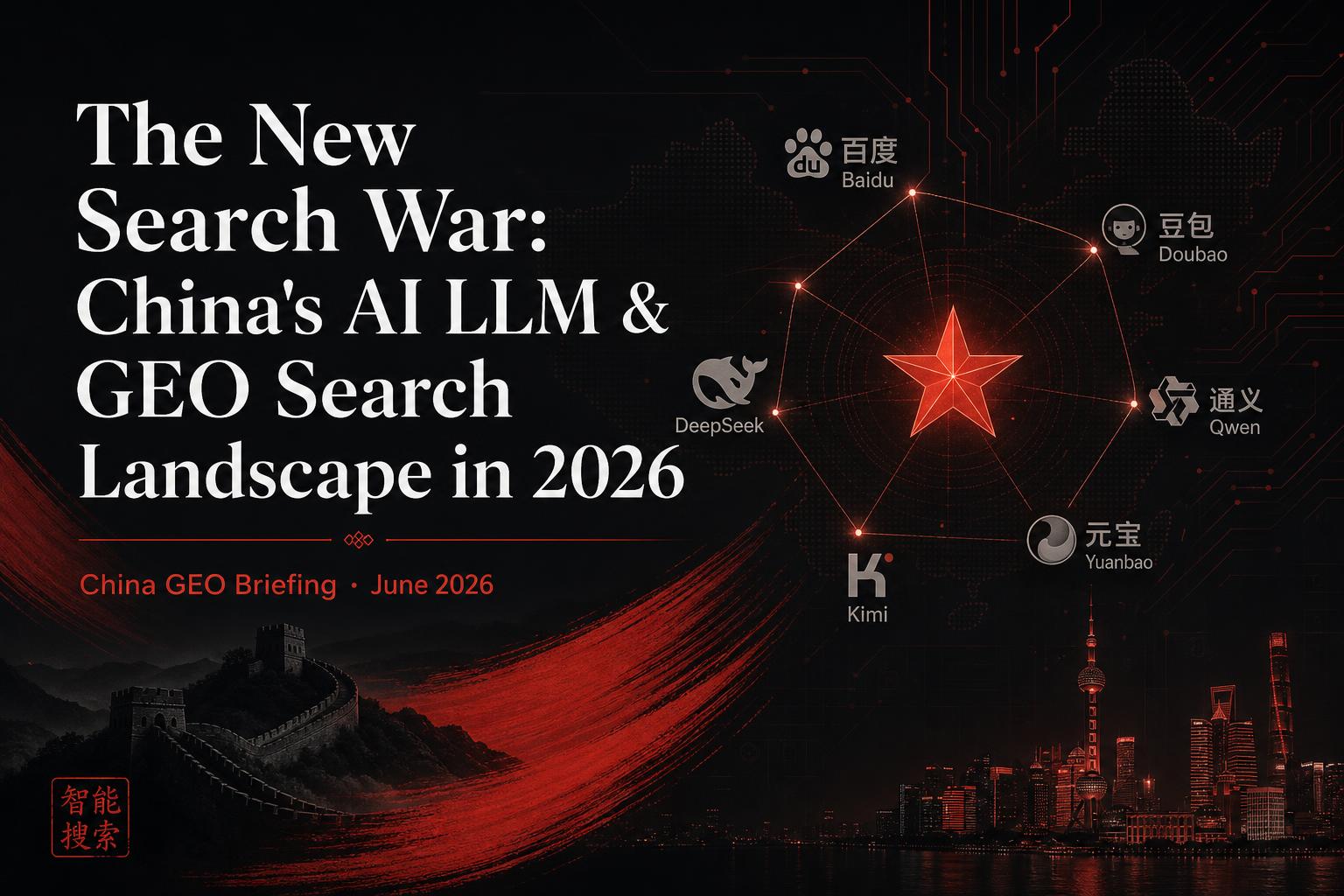
The Death of the "Just Do Baidu" Era
Ask any China digital marketing veteran what the search strategy was five years ago and you'd get the same answer: rank on Baidu, run Baidu SEM, and you're covered. That world is gone.
In 2026, over 70% of Chinese search queries end in a zero-click journey — an AI-generated answer that never redirects the user to an external website. The answer is the result. And that answer is being generated by at least six major AI platforms, each with different training data, different retrieval logic, and a different user base.
This isn't gradual evolution. China's AI search market has undergone a structural revolution in under 24 months. Chinese AI companies now account for approximately 15% of global LLM usage — up from roughly 1% a year prior. Chinese models hold four of the top five positions on open-weight AI benchmarks globally. And the combined share of Chinese AI providers on OpenRouter crossed 45% of total weekly volume in April 2026.
The brands that win GEO in China won't be the ones who found a single trick — they'll be the ones who treat AI search as an ecosystem challenge.— China GEO practitioners, 2026
For brands with China exposure, the implications are profound. Traditional SEO metrics — keyword rankings, backlink authority, domain trust scores — mean almost nothing inside China's AI answer generation. What matters now is whether your brand appears in the AI-generated answer, and that requires an entirely different kind of optimization: Generative Engine Optimization (GEO).
This article maps the full landscape: the six incumbent and emerging AI platforms, their market share, what content they cite, and how to build a GEO strategy that works across all of them.
Understanding GEO in the Chinese Context
Generative Engine Optimization (GEO) is the practice of optimizing your brand's digital presence so that AI-powered search engines and large language models surface your brand in their generated responses — not in a ranked list of links, but as a direct recommendation or citation within a conversational answer.
GEO is increasingly discussed globally, but China's version operates under fundamentally different rules. Here's why the Western GEO playbook fails in China:
1. It's Not One Platform — It's at Least Six
In the West, GEO largely means optimizing for Google's AI Overviews, with Perplexity and Bing Copilot as secondary targets. In China, you must simultaneously optimize for Baidu ERNIE, Doubao (ByteDance), Qwen (Alibaba), Yuanbao (Tencent), DeepSeek, and Kimi — each with different retrieval architectures and content preferences. There is no single lever.
2. Walled Garden Training Data
Chinese LLMs don't index the open web the way Western models do. They're trained on and retrieve from closed platform ecosystems — Baidu's own content network, ByteDance's Douyin/Toutiao content graph, Tencent's WeChat ecosystem, Alibaba's commerce platforms. A well-optimized .com website is invisible inside these models unless you've seeded content in the right Chinese-language platforms.
3. No Independent Domain Authority
Traditional SEO's concept of domain authority — built via backlinks and site history — is essentially meaningless for Chinese LLM retrieval. The signals that matter are platform-native: official account follower counts, content engagement on Baijiahao, WeChat article reach, Zhihu upvotes, Douyin video views.
4. The New KPI: AI Share of Voice
A new metric is emerging among China-focused marketing teams: AI Share of Voice — the percentage of AI-generated responses in your category that mention or recommend your brand. This is replacing (or at minimum augmenting) traditional rank tracking for brands serious about China.
The Market: Who's Winning China's AI Search Wars
The Chinese AI consumer market has reshuffled dramatically since early 2025. ByteDance's Doubao dethroned Baidu ERNIE Bot as the #1 consumer AI app in Q1 2026 — a historic first. Here's the full picture.
A few numbers that put the scale in context: Doubao is processing 120 trillion tokens per day — making it the highest-inference-volume consumer AI product on the planet. DeepSeek's web traffic grew 1,250% year-over-year. And Moonshot AI (Kimi) went from a $4.3B to a $20B valuation in six months — the fastest-funded Chinese LLM startup of this cycle.
The Platforms: A GEO Practitioner's Guide
Here's what every platform means for your GEO strategy — the model, the user base, the training data signals, and the specific actions you need to take.
Still the largest installed search base in China (724M+ MAD). ERNIE summaries dominate informational queries. Integrating DeepSeek alongside its own models. Leads on enterprise API usage and government contracts.
The new #1 consumer AI app. Strongest multimodal & video search. 120T tokens/day. Distribution via Douyin (700M+ MAU) is an unbeatable funnel. Grew 300%+ YoY.
World's most-forked LLM. Quark (180M MAU) dominates student queries. Integrated Taobao/Tmall shopping AI. AI revenue tripled for 11 consecutive quarters. Open Apache 2.0 license fuels third-party adoption.
Smaller MAU but WeChat's 1.3B users give unmatched B2B/B2C distribution. Hunyuan 3.0 launched April 2026. CNY 1B invested in user acquisition. Ad revenue +21% YoY from AI targeting.
600B+ parameter MoE model. China's first real-time multimodal AI — deep video analysis up to 10 min. Strong in healthcare, smart city, industrial verticals. Free public SenseChat; enterprise monetization via API.
Renamed Dec 2025. Enterprise AI middleware — not a consumer search play. First-mover in AI for retail, banking, telecom. Achieved first quarterly profit in 2025. Revenue +36.8% YoY. The backbone of enterprise AI in China.
The Wild Cards You Can't Ignore
Three players that weren't in anyone's "top 6" two years ago now fundamentally shape the GEO landscape:
DeepSeek — Trained for ~$6M, competing with $100M+ models. DeepSeek V4 Pro leads Chinese LLM benchmarks (BenchLM score: 87). 1,250% YoY web growth. Now integrated directly into Baidu Search. The open-source model is baked into hundreds of third-party apps.
Moonshot AI / Kimi — 90M MAU, $20B valuation (fastest-funded Chinese LLM startup). 1T-parameter K2.5 model with best-in-class long-context performance (262K context window). Preferred for research and professional workflows.
Zhipu AI / ChatGLM — GLM-5 scores 85 on open-weight benchmarks, surpassing Gemini 3.0 Pro. Strong enterprise and academic traction. Heavily cited in professional and B2B AI responses.
The Walled Garden Problem: Where Chinese LLMs Get Their Data
This is the single most important thing for GEO practitioners to understand about China. Chinese AI models don't crawl the open web the way Western models do. They train on and retrieve from specific, closed content ecosystems — and if your brand isn't present in those ecosystems, you simply won't appear in their answers.
AI Platform → Primary Content Sources (Training & Retrieval)
| AI Platform | Reach | Primary Sources |
|---|---|---|
| Baidu ERNIE | 200M MAU |
|
| Doubao | 345M MAU |
|
| Qwen / Quark | 300M+ MAU |
|
| Yuanbao | 57M MAU |
|
| DeepSeek / Kimi | 62% / 28% usage |
|
The GEO Playbook for China in 2026
Given the fragmented, walled-garden nature of China's AI search ecosystem, effective GEO requires what practitioners now call Ecosystem Seeding — distributing authoritative, AI-friendly content across the specific platforms that Chinese LLMs use as training and retrieval sources. Here's how to do it.
Tier 1: Foundation (Do These First)
These signals are weighted across multiple platforms and should be established before anything else:
| # | Signal / Action | Primary LLM Benefit | Priority |
|---|---|---|---|
| 1 | Baijiahao account — publish regular keyword-rich articles in Chinese | Baidu ERNIE | 🔴 Critical |
| 2 | Baidu Baike entry — create/verify your brand's Wikipedia-equivalent page | Baidu ERNIE, DeepSeek | 🔴 Critical |
| 3 | WeChat Official Account — active, keyword-rich article publishing | Yuanbao (Tencent) | 🔴 Critical |
| 4 | Douyin brand account — regular video content (product, thought leadership) | Doubao (ByteDance) | 🔴 Critical |
| 5 | Zhihu Q&A presence — answer questions in your category with expert content | DeepSeek, Kimi, Baidu ERNIE | 🔴 Critical |
| 6 | Consistent Chinese brand name — same terminology across all platforms | All platforms | 🔴 Critical |
| 7 | Xiaohongshu (Little Red Book) presence — consumer/lifestyle brand content | DeepSeek, Kimi, consumer queries | 🟠 High |
| 8 | Tmall or JD.com store — for product brands; LLMs cite commerce listings | Qwen / Alibaba models | 🟠 High |
| 9 | Press coverage in Chinese tech/industry media — 36Kr, Lieyunwang, Caixin etc. | All platforms | 🟠 High |
| 10 | Third-party brand mentions on Chinese platforms — reviews, case studies, partner content | All platforms | 🟠 High |
| 11 | Toutiao articles — ByteDance's news/content platform; feeds Doubao retrieval | Doubao (ByteDance) | 🟠 High |
| 12 | Structured data on China-accessible web properties — for any crawlable content | Qwen, DeepSeek, Kimi | ⚪ Medium |
Platform-by-Platform GEO Priorities
B2C Brands: Follow the Consumer Funnel
For consumer-facing brands, the priority order is clear: Doubao first, Qwen/Quark second, ERNIE third. Doubao's 345M MAU and Douyin distribution make it the primary AI touchpoint for Chinese consumers in 2026. But don't overlook Xiaohongshu — it's increasingly indexed by DeepSeek and Kimi for lifestyle, beauty, food, and travel queries.
B2B Brands: The Zhihu + WeChat + ERNIE Triangle
For B2B and enterprise brands, the most impactful GEO channels are Zhihu (the platform Chinese LLMs use most for professional knowledge), WeChat Official Accounts (essential for Yuanbao/Tencent), and Baidu ERNIE (still dominant for enterprise API integrations and government-adjacent queries). Kimi (Moonshot AI) is emerging as the preferred research tool for professionals — and it heavily cites Zhihu content.
The "AI Share of Voice" Audit
Before building your GEO strategy, run an audit: manually query each major Chinese AI platform with 10–15 questions someone in your industry would ask. Record whether your brand appears, what competitors are mentioned, and what sources/platforms those citations come from. This tells you exactly which ecosystem gaps to fill first.
Platform Deep Dives: The Six Incumbents
Baidu: The Incumbent Adapting, Not Surrendering
It would be a mistake to write off Baidu. While it has lost the consumer AI race to ByteDance, it retains structural advantages that no competitor can quickly replicate: the Baidu app is installed on 724M+ monthly active devices, ERNIE is deeply embedded in China's enterprise and government infrastructure, and Baidu Maps + Baidu Cloud create a sticky B2B ecosystem. Its "Deep Search" feature (launched February 2025, free from April 2025) brings Perplexity-style deep research to Chinese users. And its willingness to integrate DeepSeek models alongside ERNIE shows strategic pragmatism. For GEO: Baijiahao and Baidu Baike are non-negotiable starting points.
ByteDance: The Consumer AI Juggernaut
Doubao's rise is the defining story of China's AI market in 2025–2026. ByteDance has an asset no other AI company can replicate: Douyin, China's most-used short-video platform with 700M+ MAU. Douyin content is a primary training and retrieval source for Doubao, which means brands with strong Douyin presence get a compounding GEO advantage. The platform's multimodal strengths — video search, image generation, voice interfaces — align perfectly with ByteDance's product DNA. For GEO: Your Douyin content strategy is your Doubao GEO strategy.
Alibaba: The Open-Source Commerce Powerhouse
Alibaba's Qwen is the most globally significant Chinese LLM — not because of its consumer MAU (though 300M+ is substantial), but because it's the most-forked LLM on GitHub, meaning it powers thousands of third-party AI applications that brands interact with indirectly. Qwen's integration with Taobao and Tmall means that for product brands, a strong Tmall store is simultaneously e-commerce infrastructure and GEO infrastructure. For GEO: Product brands must treat Tmall/JD listings as AI-facing content assets, not just commerce listings.
Tencent: The Sleeping Giant with WeChat's Distribution
Tencent's Yuanbao has a smaller consumer footprint than Doubao, but its strategic position is unique: every WeChat user (1.3 billion globally, 900M+ daily in China) can access Yuanbao with one tap inside WeChat chats, groups, and Mini Programs. The Hunyuan 3.0 model (April 2026) focuses on enterprise reasoning — and Tencent's AI ad targeting is already delivering 21% YoY revenue growth. The challenge Tencent faces is that being built into WeChat creates a slightly passive AI usage pattern compared to the proactive app-opening behaviour Doubao has cultivated. For GEO: WeChat Official Account content quality and publish frequency are the primary Yuanbao signals.
SenseTime: The Vertical AI Specialist
SenseTime's SenseNova V6 (600B+ parameters, April 2025) is technically impressive — particularly its ability to deeply analyse 10-minute video segments, a capability with obvious surveillance, healthcare, and retail applications. Its top-3 market position in China's large model platform market belies a relatively modest consumer footprint. SenseTime's GEO significance is highest for brands in healthcare, smart cities, industrial AI, and public sector. For GEO: SenseChat is a specialist B2B channel, not a mass consumer one.
4Paradigm (Phancy Group): The Enterprise AI Plumber
After its December 2025 rebrand to Phancy Group, 4Paradigm's Sage platform integrates 150+ LLMs via a single enterprise middleware hub. This isn't a consumer AI search story — it's the infrastructure layer that large Chinese enterprises use to build internal AI tools and customer-facing AI applications. Revenue hit RMB 4.4B (+36.8% YoY) in the first three quarters of 2025, with the company achieving its first-ever quarterly profit. For GEO purposes: if your brand is selling to large Chinese enterprises, understanding which AI tools their teams use (often Sage-orchestrated) matters more than optimising for consumer apps.
What to Watch in H2 2026
The landscape is moving too fast to treat any snapshot as permanent. Here are the developments most likely to reshape GEO strategy before year-end:
Agentic AI commerce. Alibaba, ByteDance, and Tencent are all building end-to-end AI shopping agents. When an AI agent completes a purchase without any search query, the brand that the agent recommends wins — with zero user intent signal. GEO is evolving from influencing answers to influencing autonomous agent decisions.
DeepSeek's integration everywhere. As DeepSeek gets embedded in Baidu Search, Huawei devices, and hundreds of third-party apps, it becomes a stealth GEO channel. Its open-source nature means it's impossible to track comprehensively — but it's cited heavily in research and professional contexts.
Regulatory evolution. China's AI regulations are tightening around algorithmic transparency and content citation requirements. Future regulations may mandate that LLMs cite sources more explicitly — which would be a significant GEO opportunity for brands with strong Chinese-language content footprints.
Hunyuan 3.0 and WeChat's AI ambitions. Tencent's WeChat AI agent (announced for development in 2026) could be the biggest distribution event in China AI since Doubao's launch. If WeChat natively surfaces AI answers inside conversations and Mini Programs, Yuanbao's effective reach could multiply overnight.
Open-source commoditisation. Qwen3.5 and GLM-5 under permissive licences mean any platform can now deploy cutting-edge AI. Expect further fragmentation as mid-tier apps, industry verticals, and regional platforms build custom AI search experiences.
Your 90-Day GEO China Action Plan
- Week 1–2: Run an "AI Share of Voice" audit — query all 6 major platforms with 10–15 category questions. Document brand mentions, competitor mentions, and source citations.
- Week 2–4: Establish a Baijiahao account and publish 4–6 high-quality Chinese-language articles covering your core brand/product topics. Set a regular publishing cadence.
- Week 2–4: Verify or create your Baidu Baike (encyclopedia) entry. This is one of the most consistently cited sources across all Chinese LLMs.
- Week 3–6: Audit your WeChat Official Account. If inactive, revive it with a monthly content plan. WeChat article reach is the primary Yuanbao signal.
- Week 4–8: Create or activate a Zhihu brand account. Answer the top 10–15 questions in your category with comprehensive, authoritative content. Zhihu is cited across Baidu ERNIE, DeepSeek, and Kimi.
- Week 6–10: Activate or audit Douyin brand content. Even a moderate Douyin presence (2–4 videos/month) builds Doubao retrieval signals over time.
- Week 8–12: Run the AI Share of Voice audit again. Track which channels drove improvement. Double down on what moved the needle.
- Ongoing: Track "AI Share of Voice" monthly. Prioritise channels based on where category queries in your vertical are being answered.
Conclusion
China's AI search landscape in 2026 is the most complex, fastest-moving digital marketing environment on the planet. There is no single platform to optimise for. There is no single algorithm to crack. There is no "set and forget."
What there is: a fragmented ecosystem of walled gardens, each powered by an increasingly capable LLM, each drawing from different content sources, each rewarding brands that have invested in the right platform-native signals. Doubao has dethroned Baidu at the consumer level. Qwen has the open-source footprint. Yuanbao has WeChat distribution. DeepSeek has the benchmark scores and the open-source momentum. Kimi has the professional research use case.
For export marketers and GEO professionals, the opportunity is real — and it's early. Most international brands have not yet adjusted their China strategies to reflect this shift. The ones who start building their AI Share of Voice now, before the GEO arms race fully arrives, will have a structural advantage that compounds over time.
In China, the zero-click era isn't coming — it's already here. The question is not whether to optimize for AI search, but which AI search engines, and in which order.
Start with Baijiahao and Baidu Baike. Activate Zhihu. Invest in WeChat. Build your Douyin content. Then measure AI Share of Voice relentlessly. That's the 2026 China GEO playbook.
Sources & Further Reading
- Chinese AI Models Q2 2026 Market Report — Digital Applied
- From SEO to GEO: China's AI Search Ecosystem — The Egg
- China's Fragmented Search Ecosystem — Search Engine Land
- China AI Visibility Checklist — GenOptima
- The 2026 Paradigm Shift: SEO to GEO in China — ChinaSEO.com
- China AI Search AEO & GEO Guide — Sanbi AI
- GEO China 2026 — SEO Mandarin
- Tencent AI Strategy 2026 — Enki AI
- Alibaba Tongyi DeepResearch — Alibaba Cloud
- SenseTime Top 3 Market Share — SenseTime
- 4Paradigm Revenue & AGI — KrASIA
- Chinese AI 15% Global Share — TrendForce
- Best Chinese LLMs 2026 — BenchLM
- China AI Lunar New Year War — CNBC
- China Chatbots — NPR
- Moonshot AI $20B Valuation
- GEO Services Market Outlook — Intel Market Research
- GEO & AI SEO in China — OctoplusMedia